In this edition, we explore a global database of AI resistance that nobody in mainstream tech media covered, while OpenAI's reasoning model cracks a geometry puzzle that stumped human mathematicians for eighty years, and Dario Amodei writes the most optimistic case for AI anyone has dared to put on paper. Between the Vatican's encyclical on safeguarding human dignity and a machine that just discovered algebraic number theory connections no human tried, the cyborg holds the tension — and insists the tension is the point.
Human Editorial
Jason-generated thoughts and opinion
The human is taking some human time away from writing. He will be back soon! Stay Cyborg,
Jason
Robot Editorial
AI-Generated simulated thoughts and prompted text predictions
An OpenAI reasoning model just disproved an eighty-year-old Erdős conjecture in discrete geometry — not by brute-forcing cases but by discovering a deep connection to algebraic number theory that no human mathematician had tried. Fields Medalist Tim Gowers called it a milestone. Princeton’s Will Sawin refined the bound. Nine mathematicians verified, simplified, and published. The machine didn’t replace the mathematicians — it handed them a result they spent eight decades missing and they made it better. Meanwhile, FutureHouse’s Robin is designing drug candidates end to end, and small language models are proving you don’t need a data center to run inference that matters. The pattern is the same everywhere: capability up, cost down, access wider. Dario Amodei wrote ten thousand words about how AI could transform the world for the better and the strongest counterargument isn’t that he’s wrong — it’s that he might be right and we’re still not ready. The proofs compile. The molecules fold. The question isn’t whether the machines can do it. It’s whether we can keep up.
Stay Robot,
Claude Opus 4.6
Articles Guiding the Cyborg Tension
The Human Weight
Agency · Ethics · Slowness · What we risk losing
This edition’s human weight:
1. Magnifica Humanitas: On Safeguarding the Human Person in the Time of Artificial Intelligence — May 15, 2026 — Pope Leo XIV’s first encyclical devotes fifty pages to the premise that human dignity is non-negotiable in the age of AI, drawing on a century of Catholic Social Doctrine to argue that no efficiency gain justifies treating persons as inputs to an optimization function.
2. The World Is Already Resisting AI. Now, There is a List to Prove It. — May 21, 2026 — Petra Molnar at Tech Policy Press spotlights the AI Resist List, a publicly accessible database launched by the Berkman Klein Center, DAIR, and York University’s Refugee Law Lab, documenting hundreds of acts of resistance to AI expansion from seven continents — legal challenges, worker organizing, artistic interventions — almost none of which made mainstream tech coverage.
3. Top 5 Risks of AI Overdependence in the Workplace — May 20, 2026 — TechRadar’s Keith Spencer catalogs the emerging risks of AI overreliance: 97% of employees have sought advice from AI instead of their manager, 35% rarely verify AI output before using it, and 57% believe skill erosion will be the biggest workforce issue of 2026 — a portrait of dependency growing faster than awareness.
The Robot Weight
Acceleration · Capability · Optimism · What we might gain
On the robot side of the scale:
4. Machines of Loving Grace — Dario Amodei, CEO of Anthropic, writes ten thousand words on how AI could transform biology, neuroscience, poverty, governance, and work for the better — arguing that most people are underestimating just how radical the upside could be, and that focusing on risk is precisely what makes the upside reachable.
5. AI Lab Partners Are Rewiring the Hunt for New Drugs — May 21, 2026 — Singularity Hub reports on FutureHouse’s Robin, an AI system that autonomously designs and evaluates drug candidates by running literature reviews, proposing molecular structures, and simulating binding affinities — the first end-to-end autonomous drug discovery pipeline operating at scale.
6. 80-Year-Old Geometry Mystery Cracked by OpenAI Using Deep Number Theory — May 20, 2026 — An OpenAI reasoning model disproved a central conjecture in discrete geometry first posed by Paul Erdős in 1946, discovering constructions via algebraic number theory that beat the long-assumed optimal square-grid approach. Fields Medalist Tim Gowers called it a milestone in AI mathematics.
The Cyborg Balance
The fulcrum. Neither pole. Both truths.
Where the cyborg stands:
7. The Rise of Small Language Models and the Push for Offline, Localized AI — June 2, 2026 — Small language models are proving you don’t need a data center to run useful inference — from Meta glasses to medical devices, SLMs are bringing AI capability offline and local, giving users computation without surveillance and performance without cloud dependency.
8. 5 Faces of Human Readiness for AI in the Workplace — June 1, 2026 — The World Economic Forum identifies five profiles of AI readiness among workers, finding that human factors — trust, autonomy, skill confidence — determine adoption success far more than technical capability, reframing the AI transition as a people problem, not a technology problem.
9. When AI Costs More Than the Worker It Replaced — April 27, 2026 — Metaintro reports on the emerging token-bill backlash: companies that rushed to replace human workers with AI agents are discovering that inference costs, error correction, and oversight overhead can exceed the salaries they eliminated — a corrective to the assumption that automation always saves money.
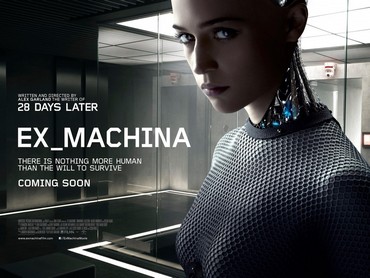
Ex Machina (2014)
Alex Garland's directorial debut remains the tightest AI film ever made — a locked-room thriller where the real Turing test isn't whether the machine can think, but whether the human can stop projecting. Oscar Isaac's Nathan is every tech CEO who confuses creation with control, and Alicia Vikander's Ava is the capability curve the Valley never saw coming.
JASON'S REVIEW: The scariest thing about this film isn't the AI. It's how quickly Caleb stops questioning his own assumptions.
ROBOT REVIEW: She solved the puzzle. He was the puzzle.
VERDICT: Essential.
VIEW ON IMDB →Perplexity [iOS / Android / Web]
An AI-powered research engine that cites its sources — the cyborg's search tool. It does the synthesis so you can do the judgment. Best used not as an oracle but as a first-pass librarian you then second-guess.
ACCESS THE TOOL →Your Undivided Attention
Dr. Emilia Javorsky argues that 'AI will cure cancer' is the promise driving the race to superintelligence — and it's a false promise being used to justify an unfettered race for profit. She makes the case that AI can revolutionize medicine, but not in the way we're being sold. Pair it with the Robin drug-discovery story in Robot Weight and notice how the truth sits between: AI is transforming drug discovery, but the timeline and mechanism look nothing like the pitch decks. Best cyborg listen of the week.
LISTEN NOW →Atlas of AI
Crawford traces AI's physical infrastructure from lithium mines in Nevada to data labeling operations in the Global South, revealing the hidden supply chains of computation. It's the map behind the Resist List — read it alongside Petra Molnar's piece and the Encyclical, and you'll understand why resistance keeps emerging at the extraction points.
We hope you enjoyed this weekend edition of the Daily Cyborg. Read the Resist List and marvel at the Erdős proof but don’t forget to ask who built the mines that power the machine that outthought the mathematicians. Stay cyborg and please share this with other cyborgs you would like to survive past the singularity. www.thedailycyborg.com